
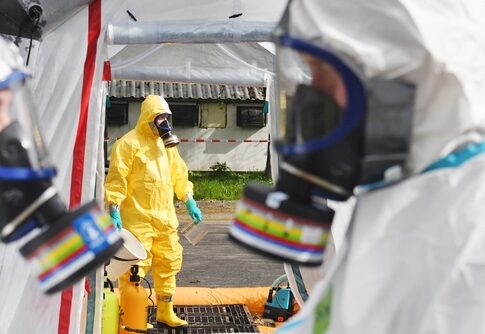
A deadly Ebola outbreak in Congo has exploded into riots, burned hospitals, and gunfire—reminding Americans what happens when fear, bad communication, and mistrust collide with emergency health powers.
Story Snapshot
- Youths in eastern Congo torched Ebola isolation tents after being denied a relative’s body for traditional burial, injuring health workers and crippling outbreak response capacity.
- Congo security officials say clear burial rules were in place, but grieving families saw them as arbitrary and disrespectful, fueling anger and street violence.
- The bodies of Ebola victims remain highly contagious, so safe-burial rules are central to stopping outbreaks, even when they clash with local custom.
- The chaos offers a sobering lesson for America: emergency health powers must be transparent, limited, and rooted in trust—or they can tear communities apart.
Rioters Torch Ebola Isolation Tents After Burial Dispute
Witness reports from Rwampara, in eastern Democratic Republic of Congo, describe a mob of angry young people storming a hospital area and setting Ebola isolation tents on fire after demanding the body of a deceased man for home burial.[1][2] A hospital official told Agence France-Presse that the youths “entered the hospital and burned the two isolation tents” when staff refused to release the body over infection fears.[1] Stones struck at least one health worker before law enforcement intervened.[1]
Video from the scene shows the Ebola treatment center burning as gunshots echo nearby and locals chase and beat a white four-wheel-drive vehicle commonly used by foreign aid groups.[2] Officials say the tents were part of an active Ebola response in a region already hit by conflict and instability.[2] The arson directly destroyed outbreak-control infrastructure at a time when safe isolation space was crucial, raising the risk that more infections will spread in surrounding communities.[2][3]
🚨Update: 🇨🇩 Chaos erupted in DR Congo after an angry mob attacked and set fire to Ebola treatment tents following the death of local football player Eli Munongo Wangu.
Residents and family members rejected the official Ebola diagnosis, insisting he died from typhoid fever.… https://t.co/O36xStxqgE pic.twitter.com/aw2OndjYNd
— The Globe & News (@TheGlobeNewt) May 22, 2026
Safe-Burial Rules Collide With Grief, Custom, and Mistrust
According to Deputy Senior Commissioner Jean Claude Mukendi, who oversees public security in Ituri Province, the riot began when family and friends tried to take the body home for a traditional funeral.[2] Mukendi stated that authorities had clearly instructed that, during this Ebola virus outbreak, “all bodies must be buried according to the regulations related to this pandemic.”[2] That means no washing, touching, or large family gatherings around a corpse that may still be highly infectious.
Reports indicate that health teams were storing bodies at the center specifically to prepare them for regulated burials designed to contain the virus.[2] A father told one outlet that as the mob attacked, his own son’s body, awaiting burial, was left inside and burned when the tents caught fire.[2] Other summaries say the deceased whose body sparked the dispute was at least a suspected Ebola case, though the available material does not show laboratory confirmation.[2][3] That uncertainty further fed mistrust among locals who already doubted outside authorities.
Ebola Outbreak Scale Raises Stakes for Public-Health Discipline
Broadcast summaries tied to the incident report that the broader outbreak involved more than six hundred suspected Ebola cases and over one hundred suspected deaths across parts of Congo and neighboring Uganda, based on World Health Organization figures.[2][3] While those numbers are not independently verified in the supplied material, they show why responders enforced strict measures. During Ebola outbreaks, the bodies of victims are among the most dangerous sources of infection, especially when families touch, wash, or kiss their loved ones during funeral rites.
Health officials repeatedly emphasized that these safe-burial rules were central to stopping the virus, not random impositions.[2] They framed controlled burials and isolation tents as critical tools in a fragile health system already strained by conflict.[2] At the same time, the evidence here does not include the full written burial protocols, case-by-case risk assessments, or detailed logs showing exactly how the tents were operating at the moment of the attack.[1][2][3] That missing documentation leaves room for locals to fill gaps with rumor and suspicion.
When Emergency Powers Outrun Trust, Chaos Follows
This Congo flashpoint follows a pattern familiar from past Ebola responses: medical necessity colliding with culture, grief, and political distrust.[3] Families see authorities refusing to hand over a body, often guarded by security forces, and conclude that officials or foreign groups are hiding something or disrespecting local custom.[1][3] In eastern Congo’s conflict zones, the presence of guns, uniforms, and foreign-branded vehicles reinforces a sense that health measures are just another top-down mandate from people who do not answer to the community.
For American readers who lived through heavy-handed pandemic orders, the warning is clear. When governments and global agencies assert sweeping health powers without transparency, clear medical justification, and grassroots trust, they risk backlash that can become violent abroad and deeply divisive at home. The Trump administration’s challenge is to learn from these failures: safeguard public health while defending constitutional limits, local authority, and family rights, so that emergency rules never become an excuse for unaccountable power or social breakdown.
Sources:
[1] YouTube – Parts of DRC Ebola hospital scorched to ground after riot by victims …
[2] YouTube – Ebola treatment center burned down amid chaos in Congo
[3] Web – Crowd sets Ebola hospital tents on fire in DRC – Apple Podcasts