
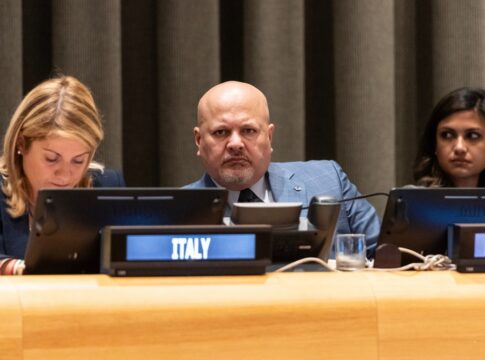
When even the world’s top war-crimes prosecutor is suspended over secretive sex-abuse findings, it confirms many Americans’ fear that powerful institutions police everyone but themselves.
Story Snapshot
- The International Criminal Court’s chief prosecutor Karim Khan has been formally suspended after a United Nations investigation into alleged non-consensual sexual contact with a female aide.
- United Nations investigators say there is a factual basis that he sexually abused an aide in multiple locations, but a three-judge panel later said the evidence did not prove misconduct beyond a reasonable doubt.
- The court’s executive bureau still ruled he committed serious misconduct and has recommended that member countries consider removing him from office entirely.
- The clash between secret reports, conflicting findings, and political crossfire is fueling global distrust in elite institutions that claim to deliver justice.
What Exactly Happened To The ICC’s Top Prosecutor?
The International Criminal Court’s chief prosecutor, British lawyer Karim Khan, has been suspended from his job after an eighteen-month investigation into accusations of sexual harassment by a female aide.[1][4] The court’s executive bureau, which is the leadership group of its member countries, ruled that he committed serious misconduct after a United Nations inquiry into the allegations.[1][2][4] The bureau has sent its confidential decision to all 125 member countries, which must now vote on whether to remove him from office.[1][2][4]
According to reporting based on the United Nations investigation, the female aide accused Khan of non-consensual sexual contact in several places, including his office, his private home, and during an overseas mission.[4][5] United Nations investigators wrote that there was a “factual basis” for her claims and that witness accounts supported her story.[4][5] This means they believed the events likely happened, even though they were not asked to decide the final legal question of misconduct or guilt.[5]
Why Are There Conflicting Findings About Misconduct?
After the United Nations investigation, a special three-judge panel chosen by the court’s member countries reviewed the same material and more than 5,000 pages of evidence.[3][5] The judges said the United Nations investigators did not clearly show which witnesses they found credible or fully resolve conflicting details in the stories.[5] Applying a strict criminal standard of “beyond a reasonable doubt,” the panel concluded that the factual record did not establish misconduct or breach of duty under the court’s legal rules.[5]
This legal assessment matters because it shows a gap between “strong evidence” and “proof beyond reasonable doubt.” The judges did not say the woman lied; they said the process and facts did not meet the highest standard of proof.[5] Their advice was not binding, yet it suggested Khan could potentially return to his duties if the Assembly of States Parties, which is the full group of member countries, accepted their view.[5] Instead, the court’s bureau later moved in the opposite direction and suspended him anyway, despite that earlier opinion.[1][3][5]
How Are Khan And His Allies Defending Him?
Khan has strongly denied all allegations and calls the case a political smear campaign aimed at stopping his investigations into powerful governments.[3][4] Through his lawyers, he says the decision to suspend him is unlawful, unfair, and unsupported by the real evidence.[1][4] His legal team points to the three-judge panel, stressing that the judges unanimously concluded the United Nations report did not prove any misconduct or breach of duty and that key disputes about the facts remain unresolved.[4][5]
Supporters of Khan also highlight how sensitive his work has become. He recently sought arrest warrants against senior Israeli leaders over the war in Gaza, on top of earlier actions involving Russian officials.[2][3] In a world where intelligence services and governments routinely wage information wars, his backers argue that sexual misconduct allegations are a powerful tool to break a controversial prosecutor without having to fight his legal cases in open court.[3] Critics counter that powerful men have long used claims of “politics” to dodge real accountability for abuse.[5]
Why This Story Fuels Public Distrust In Global Elites
The handling of this case fits a pattern that many Americans on both left and right now recognize: one set of rules for ordinary people, another for elite insiders. The bureau says it relied on a full United Nations investigation, underlying evidence, and advice from an expert legal panel, yet it keeps its final reasoning secret from the public.[2][3][4] At the same time, a different group of judges read the same file and said it did not prove misconduct, but their full report is also confidential.[5]
This tug-of-war inside a distant global court might seem far away from daily life in the United States. But the pattern looks familiar: closed-door probes, selective leaks, and leaders asking citizens to “trust the process” while hiding the details.[1][2][5] Conservatives see another global institution that lectures America on morality while failing to clean its own house. Liberals see a powerful man in a top job whose fate hinges more on politics than on a clear, transparent fact record.
What Comes Next — And Why Americans Should Care
The Assembly of States Parties will now hold a special session and vote on whether to remove Khan or allow him to return.[1][2][3] Whatever they decide, nearly all of the evidence, legal memos, and internal debates will likely stay sealed from the public.[1][4][5] That means people will be asked to accept a life-altering decision about a top global official without seeing what the judges, investigators, and diplomats actually saw when they made their calls.
This is exactly the sort of elite, shielded decision-making that has driven many Americans to lose faith in big institutions at home and abroad. Whether someone believes Khan is guilty, framed, or caught in a gray area, they are still blocked from seeing the full truth. The case shows how the modern “rules-based order” often works in practice: powerful people judging other powerful people behind closed doors, while ordinary citizens are told to simply take their word for it.[1][3][5]
Sources:
[1] Web – U.N. court chief prosecutor suspended over sexual misconduct …
[2] Web – ICC prosecutor Karim Khan suspended over misconduct allegations
[3] Web – International Criminal Court chief prosecutor Karim Khan suspended …
[4] Web – ICC prosecutor suspended over sexual misconduct allegations
[5] Web – ICC prosecutor Karim Khan cleared in alleged misconduct probe