
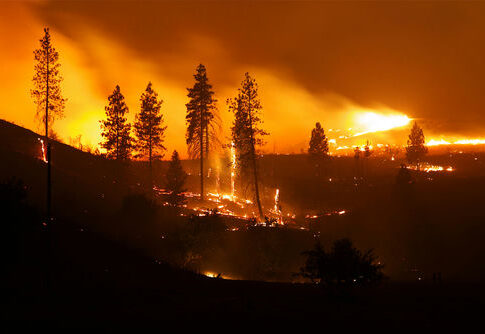
Three firefighters just died in a “burnover” on the Colorado–Utah border, and once again Washington is promising answers later while asking the public to trust a system that keeps sending people into known danger with the same old failures.
Story Snapshot
- Three firefighters were killed and two injured while battling the Snyder wildfire on the Utah-Colorado border.
- The blaze has burned about 28,000 acres with zero containment, forcing evacuation warnings for nearby Colorado communities.[1]
- Officials blame a “burnover” entrapment, but have released almost no detail about what went wrong on the fire line.[7]
- A pattern from past fatal wildfires suggests slow accountability and fast praise, feeding public distrust of federal and state leaders.[6]
What Happened On The Colorado–Utah Border
On Saturday, three firefighters were killed and two others injured while battling fast-moving fires along the Colorado–Utah border.[7] The crews were part of an interagency response when they were trapped in what officials call a “burnover,” meaning flames and heat suddenly overran their position before they could escape.[7][15] The incident happened as multiple blazes merged near the border, including the Snyder Fire, which has now burned an estimated 28,000 acres and remains at zero percent containment.[1][2]
The Snyder Fire began as the Snyder Mesa Fire in eastern Utah’s Grand County before crossing into Colorado.[1][2] As the day went on, it merged with the smaller Jones and Knowles fires burning in Mesa County to form a single, larger Snyder Fire.[1] Officials say evacuation warnings have gone out for several small communities in Mesa County as the fire spreads through dry brush and rugged terrain.[1][3] Local sheriffs have urged residents to prepare to leave quickly if full evacuation orders are issued.[3]
Official Response And What We Are Not Being Told
Colorado Governor Jared Polis declared a disaster emergency on Saturday, which allows extra funding and calls up the Colorado National Guard to help with the response.[1] The new U.S. Wildland Fire Service, created to centralize firefighting on public lands, announced the deaths overnight and praised the firefighters’ “bravery, dedication, and sacrifice” in a social media statement.[2][7] The agency has not yet released the names, ranks, or home stations of the fallen, saying families must be notified first.[1][2]
Officials have shared almost no detail about how the burnover happened beyond the basic label.[1][7] There is no public information yet about wind speed at the moment of entrapment, the escape routes available, or whether radios, engines, or shelters failed.[1][15][16] Two injured firefighters are said to be receiving treatment for burn injuries, but there are no updates on their conditions or the extent of their wounds.[2] For families, neighbors, and taxpayers, this silence leaves major questions about whether this tragedy was avoidable or a result of deeper system problems.
Why These Deaths Fit A Troubling Long-Term Pattern
Wildland firefighting experts have documented a pattern in deadly entrapments going back at least to the 1994 South Canyon Fire in Colorado, where 14 firefighters died on a steep hillside.[6] After those kinds of incidents, agencies often quickly declare an “entrapment” or “burnover” within a day, then launch a long investigation that may take months to share full findings.[14] During that time, the official message focuses on honor and heroism, while hard details about tactics, training, and command decisions come much later, if at all.[16]
Reviews of past entrapments show common issues such as weak escape routes, poor communication, and fire behavior that was faster than crews were told to expect.[18][19] Research on wildland firefighter entrapments notes that these events can occur when safety zones or escape routes do not exist, or are quickly destroyed by shifting flames.[15] A national review of entrapment incidents found recurring trends across the West, with multiple fatal events every decade in high-risk areas.[18] Many Americans, left and right, see this as evidence that leaders talk about “lessons learned” but rarely change how the system works.
Rising Wildfire Risk And Public Distrust Of The “Elites”
The Snyder Fire is only one piece of a larger wildfire crisis across the Southwest, where drought, high winds, and overgrown fuel have turned summer into a near-constant emergency.[7][13] Another blaze mentioned in local reports, the Cottonwood Fire, has grown to well over one hundred square miles and destroyed part of a ski area and cabins, showing how fast modern fires can overwhelm communities.[7] Many residents now feel that government at every level is mostly reacting after the fact, instead of fixing land management, power grid safety, and forest policy before lives are at risk.
The Nevada Office of Emergency Management extends its deepest condolences to the families, friends, and fellow firefighters mourning the tragic loss of three firefighters who gave their lives while responding to the Knowles and Gore Fires in Colorado and Utah.
Our thoughts are… pic.twitter.com/PoNwQ5cqzU
— NV Emergency Mgmt (@NVEmergencyMgmt) June 29, 2026
For conservatives, these fires can look like the result of years of missed forest thinning, confusing environmental rules, and leaders more focused on climate speeches than on clearing dead wood.[18] For liberals, they often highlight how climate change, aging infrastructure, and underfunded agencies hit rural workers and small towns hardest, widening the gap between wealthy urban areas and struggling border communities.[5][7] Both sides increasingly agree on one point: the people who die first in these disasters are front-line workers and regular citizens, not the political and bureaucratic class who designed the current system.
The Questions That Still Need Real Answers
Right now, the official story of the Snyder Fire is narrow: a burnover killed three firefighters and hurt two more while they bravely did their jobs.[7] What we do not yet know is whether commanders had accurate weather data, if crews were pushed too close to the flames to protect property, or if any equipment failed in the moment of crisis.[14][16] Federal guidelines say entrapment scenes should be carefully preserved and studied so that future firefighters are safer, but the public rarely sees those full reports.[14]
As investigations begin, many Americans will watch to see if this tragedy becomes just another line in a long list of “we will learn from this” speeches, or if it finally forces honest change in how agencies plan, staff, and fight mega-fires.[18] People across the political spectrum who are tired of excuses from the so-called elites want more than praise for the fallen; they want proof that leaders value firefighters’ lives as much as they value press conferences. Until those deeper answers arrive, the Snyder Fire burnover will stand as one more sign that the government keeps failing the very people it asks to face the worst danger.
Sources:
[1] Web – 3 firefighters killed, 2 injured while tackling wildfires on the …
[2] Web – Three Firefighters Killed, 2 Injured in Snyder Wildfire on Utah …
[3] Web – 3 firefighters killed responding to Snyder wildfire on Utah-Colorado …
[5] X – Three firefighters died and two were injured while tackling fires on …
[6] Web – Three firefighters killed, 2 injured in Snyder wildfire on Utah …
[7] Web – South Canyon Fire Entrapment Fatalities 1994
[13] Web – 3 firefighters killed, 2 injured fighting wildfires near Colorado-Utah …
[14] Web – Three firefighters killed while tackling major wildfires along …
[15] Web – [PDF] Investigating Wildland Fire Entrapments
[16] Web – [PDF] Wildland firefighter entrapment avoidance: modelling evacuation …
[18] Web – Predicting Firefighter Injury and Entrapment in Urban … – PMC – NIH
[19] Web – A review of US wildland firefighter entrapments: trends, important …