
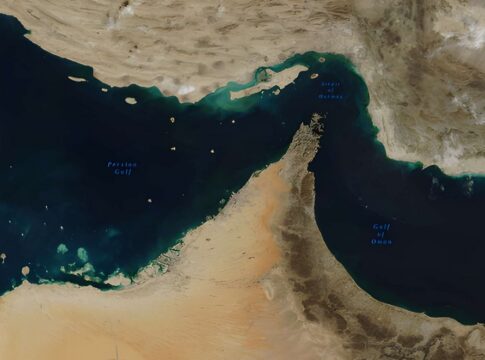
An attack in the Strait of Hormuz just tested global shipping and America’s resolve—again.
Story Snapshot
- British maritime monitors reported a tanker hit by an unidentified projectile near Oman.
- Two senior U.S. officials blamed Iran’s Islamic Revolutionary Guard Corps for a cargo-ship strike.
- U.S. Central Command said Iranian aggression violated a ceasefire, and U.S. forces struck back.
- Iran-linked sources claimed a drone hit a “violator” tanker as the regime restricts passage.
Confirmed Incident And Competing Attributions
United Kingdom maritime monitors said a tanker in the Strait of Hormuz was struck by an unidentified projectile, damaging the bridge area but leaving the crew safe. That phrasing matches other recent reports that avoid naming a weapon or a flag state until evidence is verified. U.S. and allied analysts point to Iran’s pattern of harassment and interdiction in these waters. The lack of immediate wreckage on scene leaves room for dispute, but not for comfort, as traffic faces fresh risk.
Two senior U.S. officials attributed a recent vessel strike off Oman to Iran and identified the Islamic Revolutionary Guard Corps as the actor behind the hit on the Singapore-flagged cargo ship Ever Lovely, according to major outlets. These officials linked the attack to an ongoing campaign that has targeted commercial ships during a fragile calm. U.S. Central Command later said Iranian aggression violated the ceasefire after a drone strike on the M/V Ever Lovely, underscoring the stakes for crews and cargo moving through the choke point [4][5].
Iran’s Actions In The Strait And A Risk To Energy Flow
Open-source timelines describe months of coercion at sea. Iran’s Islamic Revolutionary Guard Corps warned ships about “approved” routes, boarded vessels, and carried out attacks since late winter, according to aggregated histories. A prior December seizure near Qeshm Island also showed how Iran detains foreign crews under smuggling claims. Iran-linked media have amplified messages that a “violator” tanker was struck by a drone near the strait, signaling continued pressure on noncompliant traffic and reminding shippers that rules can shift without notice [3][1][2].
Global energy depends on this narrow waterway. Roughly a quarter of the world’s oil flows past Iran and Oman, and any hit—even one that leaves a ship seaworthy—can rattle insurers and raise costs that reach American families. Analysts have tracked a sharp slowdown and selective passage since late February, with sporadic attacks adding confusion. That pattern matches past “tanker war” tactics, where disruption, not destruction, squeezes markets and tests Western will to keep sea lanes open without sliding into a wider war [9].
What Washington Said And What Tehran Denies
U.S. Central Command stated that Iranian forces broke the ceasefire by striking a cargo ship with a drone and that American forces responded against Iranian military sites. That message aligns with U.S. officials who blamed the Islamic Revolutionary Guard Corps for the Ever Lovely strike. At the same time, Iranian diplomatic channels have denied culpability in some incidents and cast U.S. actions as unlawful, which keeps a propaganda fog over facts until debris, telemetry, or named-crew testimony comes forward to settle the details [5][4].
🇮🇷A tanker in the Strait of Hormuz was hit by an unidentified projectile, damaging the bridge.
All crew are safe, with no environmental damage reported.
— 🇮🇱news politics and more (@israelnews770) June 27, 2026
Evidence gaps remain, and that matters. British maritime reports used “unidentified projectile,” and Evergreen Marine described an “unidentified object” striking a ship near Oman. Those cautious terms reflect what mariners saw, not a lab result. Yet the larger record shows Iran warning, seizing, and striking in this corridor across many months. When a regime uses sea coercion to gain leverage, the practical effect for us back home is higher energy costs and more pressure on our Navy to guard trade without handcuffs [12][3][8].
What Conservatives Should Watch Next
First, look for recovered drone parts or clear imagery that tie the weapon to Iran’s inventory. Second, watch for crew statements from the Ever Lovely on approach vector and flight profile. Third, track satellite views for Islamic Revolutionary Guard Corps craft near the attack site and time. Fourth, note whether Tehran eases or tightens its “approved route” demands. Each step either confirms the pattern of Iranian coercion or exposes spin meant to cloud the truth and stall a united response [4].
How The U.S. Should Respond Now
Washington should keep sea lanes open and costs down without endless mission creep. That means tight naval escorts along declared corridors, rapid forensics on every strike, and clear rules that hit back at the exact units that break the peace. It also means pressing partners to share radar, satellite, and port logs in real time. When attacks hit commerce, they hit American families at the pump. Deterrence, proof, and unity are the tools that protect both liberty and livelihoods [9][5].
Sources:
[1] Web – Oil tanker hit by ‘unidentified projectile’ in Strait of Hormuz: …
[2] Web – Iran Update, December 26, 2025 | ISW
[3] Web – Iran says it hit oil tanker near Strait of Hormuz 🛢️ The Islamic …
[4] Web – 2026 Strait of Hormuz crisis – Wikipedia
[5] Web – Iran Attacks Cargo Ship, Testing Trump’s Deal to Reopen Strait – WSJ
[8] Web – Iranian Revolutionary Guards gunboats fired on two tankers …
[9] Web – Iran attacks cargo ship in Strait of Hormuz – The Telegraph
[12] Web – Why Iran would attack foreign tankers near Strait of Hormuz – CNBC