
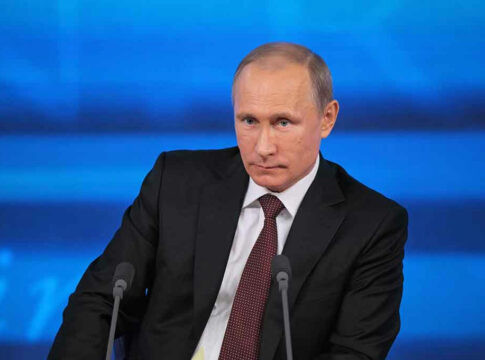
An anonymous trader placed roughly a $370,000 wager on Vladimir Putin leaving office before December 31, 2026, despite prediction markets continuing to price the outcome as unlikely.
Story Snapshot
- An unknown bettor placed about $370,000 on Putin exiting by year-end 2026.
- Prediction market pricing still shows a low chance of that outcome, near 10–14%.
- Social videos claim mutiny and market turmoil in Russia, but key details remain unverified.
- Large, anonymous political bets raise fresh insider-trading concerns in prediction markets.
What Actually Happened On Polymarket
Polymarket, a site where people bet on world events, shows a large wager on a question: will Vladimir Putin be out as Russia’s president by December 31, 2026? An unknown trader reportedly committed about $370,000 to “Yes,” making the position one of the largest on that event page. The bet drew attention because the market’s consensus price still signals long odds. Market data around the Putin contracts clusters near a low teen probability, not a coin flip.
The identity of the bettor is not public. There is no verified record of past wins tied to this wallet. That gap matters because big political bets can be stunts, hedges, or informed plays. Without a name, track record, or disclosures, the bet is only a data point, not proof of inside knowledge. Even after the wager, Polymarket’s broader pricing continues to reflect low odds that Putin leaves office before 2027.
Claims Of Mutiny And Market Stress Need Solid Proof
Viral videos claim a brewing mutiny in Russia’s military and sharp drops in Russian markets. These posts spotlight a former officer making threats and assert a five percent single-day market slide, along with dramatic claims about “red lines” and missile parts. However, these are not backed by primary documents from the Russian government, Western defense ministries, or audited financial reports. The Kremlin’s spokesperson publicly downplayed the video and said the appeal had not been formally reviewed, offering no confirmation of dissent.
Because verification is thin, these stories should be treated with caution. Some clips have been flagged as contested. When facts are unclear, markets normally discount them, which may explain why prices still imply a high chance Putin remains in power through year-end 2026. That does not prove the videos are false; it shows traders have not seen enough reliable evidence to change the odds in a big way.
Why A Big Anonymous Bet Matters Beyond Russia
Large, anonymous wagers on geopolitical shocks are part of a growing pattern. Newsrooms and investigators have reported dozens of cases where tightly timed bets on war moves or leadership changes paid out fast and big. These patterns have fueled public worries about insider trading and the use of nonpublic government or military information to make money on prediction markets. Reported cases tied to Middle East strikes and other flashpoints have sharpened these concerns.
An unknown investor has bet $370,000 that Putin will step down as President of the Russian Federation by the end of 2026.
The bet was placed on the prediction platform Polymarket.Trump? pic.twitter.com/La8hmYbsPw
— Jürgen Nauditt 🇩🇪🇺🇦 (@jurgen_nauditt) July 1, 2026
Regulators and lawmakers are now watching these platforms more closely. Reporting has described clusters of linked accounts that won at striking rates on precise dates for military actions, profiting in ways that look unusual when compared with normal trading patterns. For readers on the left and right who already doubt elite accountability, this raises a familiar fear: people close to power may be monetizing secrets while the public stays in the dark.
How To Read The Odds Without Getting Spun
Prediction markets can be useful thermometers, not crystal balls. Prices reflect the crowd’s current read of risk, liquidity, and the balance of buyers and sellers. One whale bet can move headlines, but it does not overrule the wisdom—or the limits—of the crowd. Here, the market still prices a low chance that Putin leaves by year-end 2026, which suggests most traders have not seen reliable signals of imminent change in Moscow.
Practical takeaway: separate three buckets. First, confirmed facts from named, primary sources. Second, market prices that show what traders believe right now. Third, viral claims that may or may not check out. Today, bucket one confirms the bet and the low odds. Bucket two shows skepticism that Putin falls this year. Bucket three is noisy and unverified. Until stronger evidence appears, that is where things stand.
What To Watch Next
Watch for official records or court filings in Russia that support or refute claims of high-level purges or dissent. Look for statements from the United States Department of Defense or the United Kingdom Ministry of Defence that confirm or deny alleged strikes that supposedly crossed “red lines.” Keep an eye on Polymarket order flow for fresh large buys or sells that might shift the odds. Above all, demand sources you can name and documents you can read.
Sources:
mediaite.com, wsj.com, x.com, manifold.markets, chinatalk.media, nytimes.com